The Horizon · A story from Rumi’s Masnavi

The Elephant in the Dark
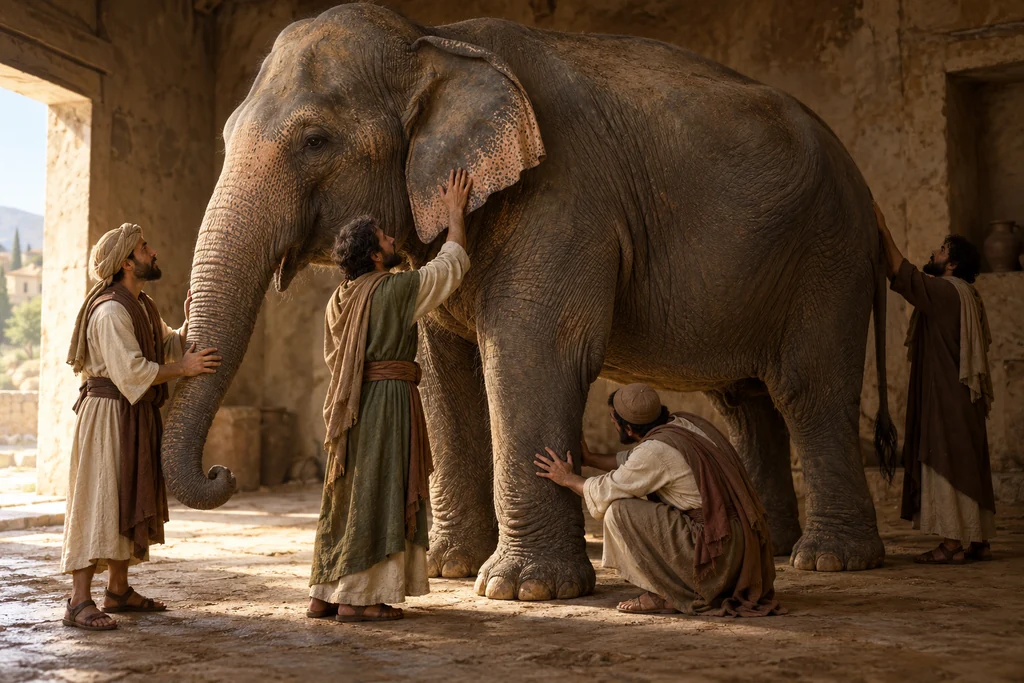
Visitors feeling an elephant’s trunk, ear, and leg inside a room.

Rumi tells of people who brought an elephant from India to show to others, and placed it in a dark room. Visitors came to see the animal they had heard about, but the darkness hid it from their eyes.

The room was so dark that they could make out neither its outline nor its features. Each reached out to feel whatever lay nearest, hoping to discover through touch the shape of the great creature they had come to see.

Visitors feeling an elephant’s trunk, ear, and leg inside a room.

One hand reached the trunk, and its owner imagined the elephant as a long waterspout. Another found an ear and felt the shape of a broad fan. The visitor who grasped a leg discovered something like a pillar. A fourth laid a hand on its back and thought of a throne.

Each impression came from something a hand had touched, from the place where its owner stood. Behind all these impressions was one elephant, larger than any single hand could reach.

Visitors feeling an elephant’s trunk, ear, and leg inside a room.

The visitors began to describe what they had discovered. Their words differed as their positions had differed. What seemed long to one seemed broad to another, and upright and solid to a third.

Each described the whole elephant through the part they knew. No one had to be lying for their accounts to differ. It was enough to take one aspect for the whole.

Visitors feeling an elephant’s trunk, ear, and leg inside a room.

Rumi pauses over the light that might have changed the encounter: had each visitor carried a candle, these differences in their descriptions would have disappeared.

The candle remains a possibility held within the story, showing what those searching hands lacked. Rumi then extends the parable to the limits of knowledge through the senses and to the light of spiritual insight in his Sufi tradition.

Reflection

What we know may be true without revealing the whole picture. Disagreement can invite us to ask where another person is standing, and what evidence or experience is still missing.

What part do you know well enough that you may have mistaken it for the whole?

Alrewaq
Read as text

Rumi tells of people who brought an elephant from India to show to others, and placed it in a dark room. Visitors came to see the animal they had heard about, but the darkness hid it from their eyes.

The room was so dark that they could make out neither its outline nor its features. Each reached out to feel whatever lay nearest, hoping to discover through touch the shape of the great creature they had come to see.

One hand reached the trunk, and its owner imagined the elephant as a long waterspout. Another found an ear and felt the shape of a broad fan. The visitor who grasped a leg discovered something like a pillar. A fourth laid a hand on its back and thought of a throne.

Each impression came from something a hand had touched, from the place where its owner stood. Behind all these impressions was one elephant, larger than any single hand could reach.

The visitors began to describe what they had discovered. Their words differed as their positions had differed. What seemed long to one seemed broad to another, and upright and solid to a third.

Each described the whole elephant through the part they knew. No one had to be lying for their accounts to differ. It was enough to take one aspect for the whole.

Rumi pauses over the light that might have changed the encounter: had each visitor carried a candle, these differences in their descriptions would have disappeared.

The candle remains a possibility held within the story, showing what those searching hands lacked. Rumi then extends the parable to the limits of knowledge through the senses and to the light of spiritual insight in his Sufi tradition.

Reflection

What we know may be true without revealing the whole picture. Disagreement can invite us to ask where another person is standing, and what evidence or experience is still missing.

What part do you know well enough that you may have mistaken it for the whole?

Alrewaq
About this story & sources

An English retelling of Alrewaq’s Arabic adaptation of Jalal al-Din Rumi’s Masnavi, Book III, lines 1259–1274. The Arabic text was checked against E. H. Whinfield’s historical translation and the text and numbering published by Dar al-Masnavi. The visitors can see, but the room is dark. The candle remains a hypothetical possibility, not an event added to the ending. Rumi develops the parable within his Sufi discussion of perception and spiritual insight.